Borrow, Rent, or Own? Matching Access to How Often You Use It
Borrow, rent or own by weighing use, access, storage and care, then choose a workable way to get the item without taking on avoidable duties.
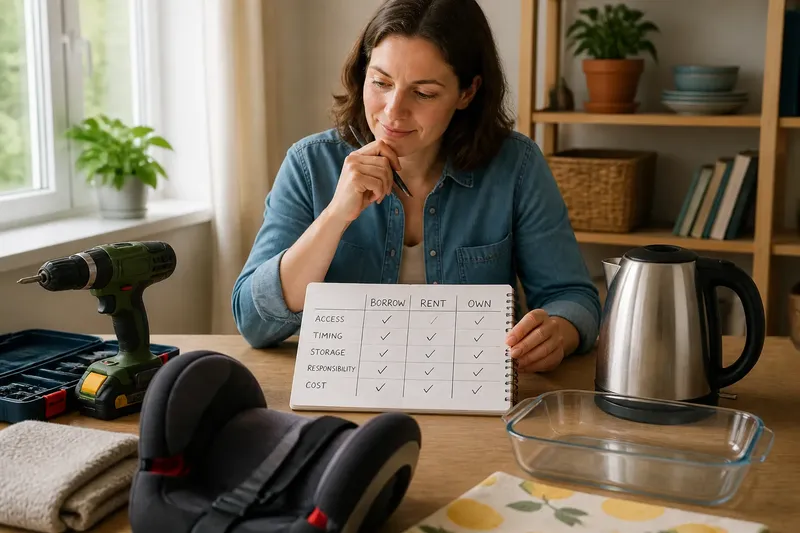
Should you borrow, rent or own the item you need? For a drill to hang shelves, borrowing or renting may suit a one-off job; a kettle used every morning is a different choice. Borrow, rent or own decisions depend on how often you will use an item, but also on access, storage and responsibility.
Start with the job, then compare the arrangements. You are choosing a reliable way to get access, not proving that one option is always more resourceful.
Define the job
Write down what the item must do, where you will use it and when you need it. Include features that determine whether it will work: a particular drill bit, a child seat that fits your car, or a serving dish large enough for the meal. Naming the task precisely helps you avoid choosing a broad category such as “a tool” when you need a masonry drill.
Separate essential requirements from preferences. A particular colour may be optional; a safe fit or compatible attachment may not be. This lets you consider an available borrowed item without accepting one that is unsuitable.
Check for a workable substitute you already have. A hand whisk might manage a small batch, while a large mixing task may call for a powered mixer. Use the substitute only if the result will be acceptable and the extra effort is reasonable.
Estimate your use
Consider the item’s likely use over a period that fits the task. Is this a one-off job, something that returns each season, or part of your routine? Do not count imagined projects as scheduled work. A vague hope to take up woodworking is weaker evidence than jobs you have already planned.
Look at the pattern, not just the number of uses. A carpet cleaner needed for one weekend may suit a hire, even if you plan to clean several rooms, because those jobs happen together. A sewing machine for occasional repairs may be borrowed as needed, unless access is unreliable or each visit takes too much coordination.
Frequency is a clue, not a verdict. A rarely used item may be worth owning if you need it at short notice and cannot count on access. A frequently used item may still be borrowed if a suitable one is shared within your household and available when required.
Check access and timing
For borrowing, ask the owner before you plan around the item. Agree on collection, how long you may keep it and whether anyone else has priority. “You can use it sometime” does not mean it will be available on the day your task is booked.
For renting, check the collection and return window, what is included and whether you need to reserve. Factor in the journey and the time spent arranging the hire. A rental may not fit a task that could run late if you must return the item before the work is done.
For ownership, ask whether you need immediate access or can wait for a suitable second-hand item or shared scheme. If safety, compatibility or local rules matter, consult the manufacturer’s instructions and relevant local guidance.
Say you need a wallpaper steamer for a room you plan to clear over a weekend. Your neighbour confirms you can borrow theirs for the whole period, and it suits the wall covering. Borrowing gives you access throughout the job without arranging a hire return. If the neighbour needs it back the next morning, that arrangement no longer fits; renting for a suitable window is more workable. Owning would need a separate reason, such as other decorating jobs already planned.
Count the hidden work
Borrowing means respecting the owner’s plans and returning the item in the agreed condition. Renting adds a deadline and the hire provider’s conditions. Owning avoids those return arrangements but makes you responsible for storage, upkeep and eventual disposal or transfer.
Imagine you need a folding table for a family gathering. A friend has one, but lives across town and needs it back early the next day. If collecting and returning it would crowd out preparation, a nearby hire service could be easier. The table is available for the gathering, while your friend keeps theirs and you avoid an awkward return trip.
Storage has a practical cost even when an item is free. Decide where it will live, whether it needs to stay dry or clean, and whether it will obstruct something you use more often. Do not treat cupboard space as unlimited simply because no payment is due.
Compare each option
- Borrow: Check that a suitable item is available when needed. If the owner confirms the timing and the return is manageable, borrow it; otherwise, ask about hiring or another source.
- Borrow: Check how much travel and coordination collection requires. If both are manageable, borrowing remains an option; if not, compare a nearby hire service or ownership.
- Rent: Check that the hire window covers the whole task. If it does, rent for the defined job; if it does not, arrange a longer window or consider borrowing or owning.
- Rent: Check the collection and return conditions. If you can meet them, hiring may fit; if not, choose an arrangement with more flexible access.
- Own: Check whether you expect recurring or unpredictable use. If dependable access would solve a real need, consider ownership; if use is speculative, borrow or rent for the confirmed task.
- Own: Check that you have a suitable storage place and are willing to care for the item. If both are true, ownership remains practical; if either is false, use a shared or rented option.
- Any option: Check whether the item meets the essential requirements. If it does, compare access and duties; if it does not, reject it and look for a suitable alternative.
Compare the whole commitment, not only the payment. For a rental, include travel and the return obligation. For a borrowed item, include coordination and the possibility that agreed timing changes. For ownership, include the space it occupies and the attention needed to keep it usable.
It is not worth building an elaborate spreadsheet for a minor, one-off need. A few notes on timing, access and storage will usually expose the main trade-off. Save detailed comparisons for an item that is costly, awkward to store or likely to become a recurring need.
Questions about access?
Is borrowing always the cheapest choice?
No. An item with no hire charge may still involve inconvenient travel, careful coordination or an awkward return. Compare the full arrangement, including your time and obligations, with renting or owning.
When does renting make sense?
Renting often suits a defined task when you need temporary access and do not want to store the item afterwards. Check that the hire window covers the work and that collection and return are practical.
How often should I use an item before owning it?
There is no universal frequency threshold. Consider your actual routine, how predictable the need is, how easily you can get access another way, and whether you have room and willingness to care for the item.
What if I need the item unexpectedly?
Unpredictable needs can make dependable access more valuable than a simple count of past uses. If ownership is impractical, identify a nearby borrowing or rental option before you need it.
Make the choice workable
Settle practical details before the task begins. For a loan, agree on collection, return and how to report a problem. For a rental, note the return conditions and set a reminder that leaves room to finish the job. For an owned item, choose an accessible storage place and keep any care instructions with it.
Afterwards, note what made the arrangement easy or difficult. If borrowing required repeated chasing, favour a more reliable source next time. If a rented item sat unused because plans changed, reconsider when to arrange the hire. The right borrow, rent or own choice matches the job and your access needs without adding more duties than the item solves.