Why a Refill Works: The Design Logic of Reusable Containers
Reusable container design separates a durable vessel from replaceable contents, helping you choose formats that are convenient to refill, clean and keep.
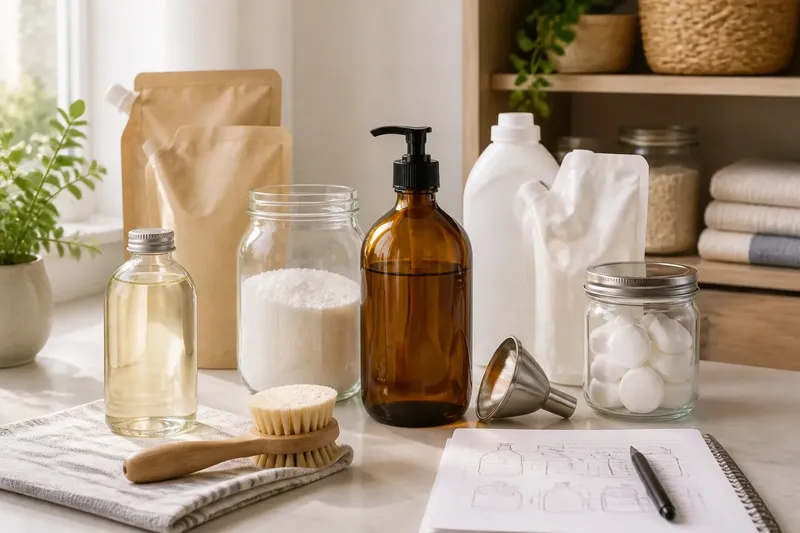
Why does a refill container work well in one cupboard but become an awkward object in another? Reusable container design succeeds when the lasting vessel and replaceable contents behave as a useful pair: the container earns its place through repeated use, while the refill replaces only what runs out. The shape, opening, closure and cleaning demands all affect whether that arrangement is easy to maintain.
The idea is simple, but the details matter. A refill format is not automatically convenient because it uses less packaging or looks tidy on a shelf. It must suit the product, the person handling it and the routines around storage and cleaning. Looking at the design as a system makes it easier to judge whether a particular container is a sensible choice.
The vessel and its contents
A refill system divides a product into two parts. The durable vessel holds and dispenses the product; a replaceable portion supplies what has been used. In a hand-soap dispenser, for instance, the bottle and pump are the vessel, while the soap is the content. A jar that takes a separately sold replacement insert follows the same principle, though its opening and closure may work differently.
This division is useful because the two parts have different jobs. The vessel needs to stay functional through handling, storage and cleaning. The contents need to be replenished in a form that can be transferred, inserted or connected without making the process cumbersome. A well-considered design avoids replacing a working vessel simply because its contents are finished.
That does not mean the vessel must last indefinitely, or that every refill package is preferable. The point is to make the reusable part practical enough to keep using, rather than treating it as a decorative object that is difficult to fill or care for.
Refill container design
Good refill container design begins with the movement of the contents. A thick cream, loose powder and thin liquid do not pour or dispense in the same way. The opening, neck, insert or pump should suit the product’s consistency and the way it is supplied. If a refill requires careful funnel work every time, the arrangement may be less convenient than a container with a wider opening or a transfer-ready insert.
Consider the whole route from storage to use. A refill packet may need a stable place to sit while it is opened. The vessel may need to fit beneath a tap, in a bathroom cabinet or beside a kitchen sink. A pump can make frequent dispensing neat, but it adds a component that needs cleaning and can be difficult to reach inside. A wide-mouth jar may be easy to refill and wash, yet less suited to a liquid that should be dispensed in small amounts.
Look at these features together rather than treating them as separate selling points:
- Opening: Is it wide enough for the refill format, a funnel or a cleaning brush?
- Stability: Can the vessel stand securely while contents are poured or scooped?
- Closure: Does the lid or pump close firmly and remain manageable to remove?
- Dispensing: Can you take out the intended amount without awkward shaking or spills?
- Grip: Is the vessel comfortable to hold when wet, full or being cleaned?
- Storage: Does its shape fit the shelf or cupboard where it will actually live?
None of these features needs to be elaborate. A plain glass jar with a broad mouth may suit a dry household product; a sturdy bottle with a compatible pump may suit a washroom. The useful design is the one that supports the action you repeat, not the one with the most parts.
Refill formats compared
Refills arrive in several forms, and each asks something different of the user. A pouch is flexible and may pour through a spout, but its opening can be difficult to control if the vessel’s mouth is narrow. A bottle-shaped refill may be easier to pour, though it still has a rigid package that needs storage. A replacement cartridge or insert reduces transfer work, but only fits a vessel designed to accept it.
Bulk containers can suit someone who has a clear place to store them and a straightforward way to top up smaller vessels. They can be inconvenient where cupboard space is tight or where handling a heavy container is awkward. Concentrated contents require another action, such as adding water, so the user must have a suitable measuring or mixing routine. The right format depends on what it asks you to do, not just on the word “refill” on the label.
Say you keep hand soap beside a small basin with limited counter space. A tall bottle may fit, but a wide pouch could be awkward to pour into it. A refill bottle with a narrow spout, or a vessel whose pump can be removed easily, may make replenishing less fiddly; the observable benefit is a cleaner transfer and less need to move other items out of the way. If the cupboard is the main constraint instead, the refill’s shape and storage position may matter more than its pouring speed.
Cleaning and upkeep
A reusable vessel needs a realistic care routine. Residue can collect around a neck, under a lid or inside a pump, and a narrow opening can make thorough cleaning difficult. Before choosing a container, consider whether its parts come apart for ordinary washing and whether you can reach the areas that contact the contents. A container that is hard to inspect may be harder to keep in good condition.
Follow the product label and the container or dispenser maker’s instructions for cleaning, drying and refilling. This matters especially when contents may react with one another, need a particular storage condition or should not be mixed with remnants. If the instructions call for a clean, dry vessel, build in enough time for it to dry before refilling rather than topping it up automatically.
Routine maintenance need not become a project. Keep the brush or cloth used for the vessel somewhere accessible, and notice whether a seal, lid or pump is becoming difficult to handle. A worn closure can make a once-convenient container messy; replacing a compatible part, where available, may be simpler than abandoning the whole vessel.
What is not worth the effort is keeping an awkward container solely because it was intended for reuse. If it cannot be cleaned properly, does not suit the refill format or creates repeated spills, look for a more workable pairing rather than turning each refill into a chore.
Where convenience breaks?
Does every container suit a refill?
No. A vessel is a good candidate when it can be filled, closed, stored and cleaned in ways that suit its contents. Some packages are designed for single use or have openings and components that make repeated filling impractical.
Should the refill match the brand?
Use a refill intended for the vessel and product, especially where a cartridge or dispensing mechanism depends on a specific fit. For other containers, check compatibility and the maker’s directions instead of assuming that similar-looking contents can be combined.
What makes a refill less messy?
A stable vessel, an opening suited to the refill spout and a transfer method you can control all help. A funnel can be useful for some combinations, but it adds another item to wash and store.
When should a vessel be replaced?
Replace it when damage, a failing closure or persistent residue makes it unsuitable for its intended use. If only a removable component is worn, check whether a compatible replacement part is available before discarding the vessel.
Choosing a workable pair
Assess the container and refill together before making space for a new system. Check whether the contents are available in a format you can handle, whether the vessel fits where it will be used and whether cleaning is manageable with the tools you already own. A neat-looking bottle is less useful if it needs a special funnel that is always missing or cannot be opened comfortably.
It can help to follow the actual sequence in your mind: take the refill from storage, open it, transfer or insert the contents, close the vessel, clean any residue and put everything away. Each action should have an obvious place and method. If one stage seems awkward, identify whether the problem is the refill package, the vessel or the location where you plan to use it.
For a low-commitment trial, begin with a vessel you already own if it is clean, suitable for the contents and compatible with the refill instructions. Avoid collecting multiple containers before you know which format fits your routine. If a refill is only sold in a size or form that is inconvenient to store, a different product format may be the more thoughtful choice.
Reusable container design is ultimately about keeping the useful part in service while making replenishment ordinary. Choose a vessel that is easy to hold, open, fill and clean; pair it with a refill that fits its shape and your storage habits. The best reusable container is not the one that promises the most reuse, but the one whose small, repeatable tasks remain easy enough to do.